

In August, MACH and the Melbourne Medical School Research Training Academy hosted Getting Started as a Post-Doctoral Clinician Scientist – a symposium where attendees gained a raft of invaluable insights and guidance for their burgeoning clinician scientist careers.
The event was celebrating the launch of our new collaborative MacCS (Melbourne academic centre Clinician Scientists) Network – chaired by Professor Sir John Savill and Professor Margie Danchin, with a steering committee of clinician scientists committed to identifying and addressing the gaps that are often encountered.
Two of its members – Paediatric Respiratory Specialist Dr Shivanthan (Shiv) Shanthikumar from The Royal Children’s Hospital and Ophthalmologist Associate Professor Lisa Zhuoting Zhu from the Centre for Eye Research Australia – discuss the insights gained at the event and how MacCS can support Melbourne’s future leaders of clinical research.
Why is a group like MacCS so important?
Lisa: Having a structured support network is invaluable, not only for mentorship and collaboration but also for guiding clinicians toward a research pathway. It encourages more clinicians to pursue the clinician-scientist track, which is essential for translating clinical insights into impactful research.

Shiv: Having support for the graduate clinician-researchers is vitally important. The early post-doctoral years are often referred to as the ‘valley of death’, as it is a period where clinicians are often lost to research.
This is especially true in Australia whereas, compared to places like the United Kingdom and the U.S., there is less dedicated support for clinician researchers. At the event, we heard from Professor John Savill about how successful a support group like MacCS was in Edinburgh.
The hope with MacCS is that, by bringing clinician researchers together in their early post-doctoral period, we’ll be able to support each other and help everyone pursue successful long-term research careers.
What insights did you share at the event?
Lisa: I discussed my personal journey as a clinician-scientist – emphasising the unique opportunities that come with bridging clinical practice and research.
The clinician-scientist pathway allows us to directly address clinical challenges with innovative research, and I highlighted the advantage of being able to see the immediate impact of our work on patient outcomes.

I also offered grant application tips, underscoring the importance of crafting a compelling narrative, aligning research goals with funding priorities and leveraging collaborations to strengthen applications.
Shiv: I presented on my experience of benefitting from an institutional scheme that supports clinician-researchers make the transition from PhD student to post-doc.
At the Melbourne Children’s Campus, I’m lucky to be supported by the clinician-scientist fellowship scheme, which has provided me with protected research time in the years after I completed my PhD.
I highlighted how the fellowship allowed me to broaden my research interests, benefit from a community of peers and say ‘yes’ to unexpected opportunities.
What were some key takeaways from the panel session?
Lisa: The panel discussed balancing clinical and research responsibilities, navigating the training landscape with the right support and managing family commitments.
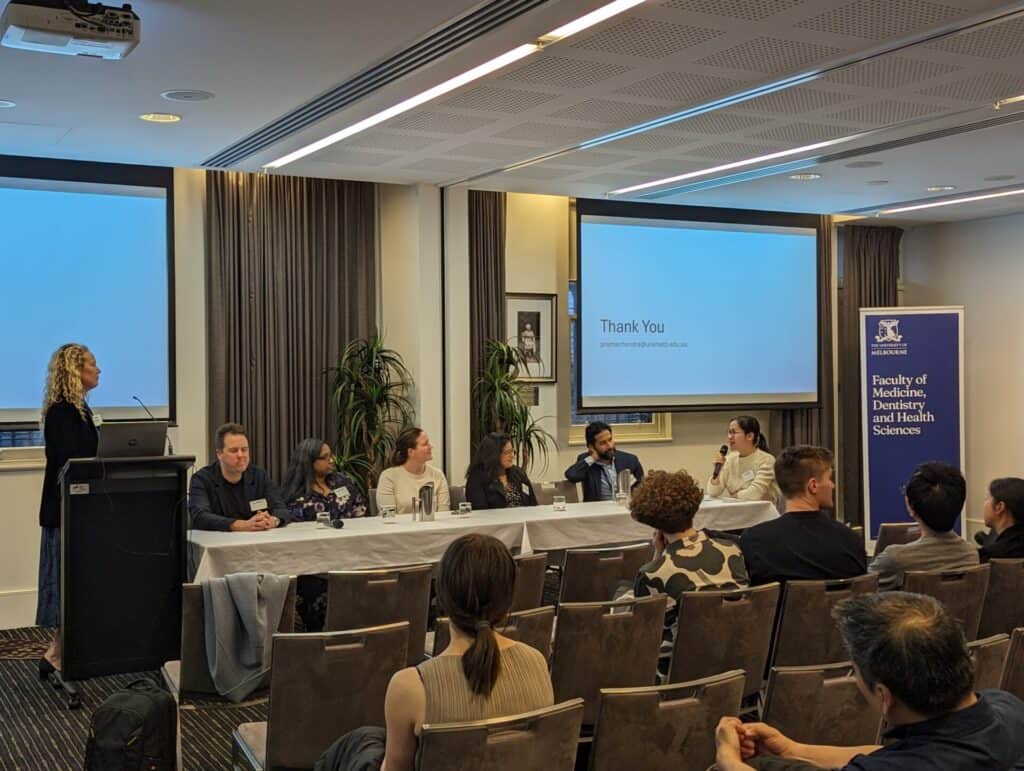
These are crucial factors that influence success in both clinical and research careers – and we discussed strategies for sustaining long-term productivity across both roles.
Shiv: We also discussed how to navigate the transition to post-doc researcher. This included topics such as transitioning back to Australia from working abroad, obtaining clinical and research jobs and how to have success in obtaining grant funding.
Some other common themes that arose during the presentations included the importance of having mentors/sponsors, some unique challenges in the Australian system and, most importantly, the rewarding nature of being a clinician-scientist.
Join our network of future healthcare leaders
If you’re an early to mid-career clinician scientist from any discipline affiliated with a MACH partner, find out how you can join this dynamic, peer-run network.