
AI Training and Events
Browse upcoming and recorded AI for research training and events offered across the MACH network. See details for eligibility and entry requirements.

Upcoming events
WEBINAR SERIES: AI in Research Brown Bag series
Host: Melbourne Data Analytics Platform (University of Melbourne)
Practical, hands-on workshops to help you use AI confidently in your research. Bring your lunch, bring your curiosity.
Date: September-December 2026
Location: In-person and online
Cost: Free (all welcome)
About the series: Whether you’re just getting started with AI or looking to sharpen your skills, these monthly lunchtime sessions are for you. Brought to you by MDAP, QuantLab, and the Community of AI in Research, our Brown Bag series offers a relaxed, informal space to learn, experiment, and connect with others across the University.
Sessions are open to everyone, from PhD students and early-career researchers to senior academics, across all disciplines.
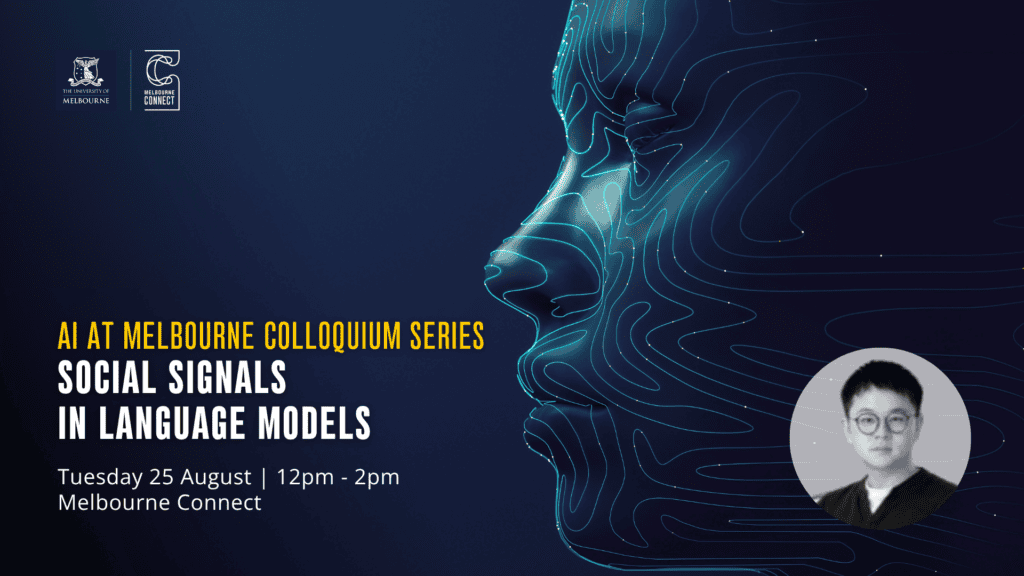
WEBINAR SERIES: AI at Melbourne Colloquium
Host: Melbourne Connect (University of Melbourne)
Date: Ongoing
Location: In person
Cost: Free (all welcome)
About the series: Melbourne Connect’s Colloquium Series on Artificial Intelligence brings leading researchers from around the world to discuss key developments in AI. Covering topics like machine learning ethics, AI in healthcare, and the impact of automation, the series provides a platform for rigorous academic debate and knowledge exchange.

EDUCATION SERIES: 2026 Faculty of Medicine, Dentistry and Health Sciences AI Education Series
Host: Faculty of MDHS (University of Melbourne)
Date: Ongoing
Location: In person and online
Cost: Free (open to University of Melbourne staff)
About the series: The series is aimed at graduate researchers but open to supervisors, professional staff, and academic educators across the MDHS Faculty. Whether you’re new to AI tools or looking to deepen your understanding of their use in biomedical research, academic writing, or healthcare analytics, the program is designed to provide practical skills and strategic foresight suitable for all levels of experience. 2025 series webinar recordings are publicly available.
Upcoming session: AI and Digital Health Support for Researchers
Date: Postponed – date TBC
Location: online
About the session: This session will provide an overview of how the Centre for Digital Transformation of Health supports AI and digital health research across MDHS. It will highlight the Centre’s services, expertise and infrastructure, and outline how researchers can engage for advice, collaboration and support. Professor Peter Steel (pictured) will speak to common challenges researchers face when working in AI and digital health, and how the Centre can help address these. Registrations for this event will open in August.
Past events
Data Analytics & AI in Health
2026 – Melbourne Data Analytics Platform (MDAP)
Presenters: Dr Noel Faux, Dr Mel Mistica & Priyanka Nair-Turkich
About the Topic: Melbourne Data Analytics Platform (MDAP) is a multidisciplinary team of research data specialists, with backgrounds ranging from astrophysics, bioinformatics, political history, to neurosciences. With central skills around computational and data science, from data management, machine learning, to natural language processing. The team supports research projects across all faculties at the University of Melbourne at all stages of the research life cycle. In this seminar we will give an overview of a few collaborative research projects, highlighting our expertise in AI, deep learning, natural language processing and data linkage, and agent-based computational modelling.
_________________________________________________________________
What clinicians and EMCRs need to know about AI and healthcare
2026 – Centre for Digital Transformation of Health (University of Melbourne)
Presenter: Vlada Rozova (CDTH)
About the topic: AI is reshaping healthcare. This session cuts through the hype to focus on what clinicians and early-to-mid career researchers actually need to know: how AI tools are being used in clinical settings right now, what the evidence does and doesn’t yet support, and how to critically evaluate the wave of applications heading your way. Whether you’re developing your own AI algorithm or just interested in knowing more, this is your grounding in the essentials.
_________________________________________________________________
AI in Healthcare: The (Future) Role of Clinical Artificial Intelligence
2025 – Centre for Digital Transformation of Health, (University of Melbourne)
Presenters: Dr Vlada Rozova (CDTH) and A/Prof Daniel Capurro (CDTH)
About the topic: How are artificial intelligence and machine learning algorithms being used in healthcare? Showcasing real-world examples, this session will cover the role of design thinking, data sources and access, feasibility testing and tool development using rule and ML-based inference for automated assessment.
_________________________________________________________________
Designing health research projects that leverage digital technology – part 1
2024 – Centre for Digital Transformation of Health, (University of Melbourne)
Designing health research projects that leverage digital technology – part 2
2025 – Centre for Digital Transformation of Health, (University of Melbourne)
Presenters: Dr Kit Huckvale (CDTH) and Dr Olivia Metcalf (CDTH)
About the topic: Have you dreamed about the ways in which health care can be improved through technology? Do you have a great idea for an app, or AI algorithm, or EMR tool that can transform healthcare? The digital transformation of healthcare is underway, but many hurdles face health researchers when it comes to designing successful research projects. The Validitron team is experienced in digital health research, and collaborates with researchers who have great ideas and need help. This seminar will introduce you to digital health research methods.
_________________________________________________________________
AI in Healthcare: a balancing act between tremendous potential, technical feasibility, and user needs
2024 – Centre for Digital Transformation of Health, (University of Melbourne)
Presenter: Dr Vlada Rozova (CDTH)
About the topic: It is tempting to throw sophisticated machine learning models onto rich clinical datasets to find patterns that will benefit both patients and clinicians. But where does one start? And how to ensure the solution will have a positive impact, if any? How can user-centered design guide the development of machine learning models at the backend: a case study. Dr Vlada Rozova from the Centre for Digital Transformation of Health, will unpack these questions and provide insights on how where to start.
Faculty of MDHS AI Education Series 2025
The University of Melbourne
Session 3: Leveraging AI for Big Data and Healthcare Analytics
About the topic: Discussing how AI facilitates management and analysis of large healthcare datasets, machine learning for data interpretation, and public health predictions.
Session 2: AI in Data-Driven Biomedical Research
About the topic: Focusing on AI’s role in advancing research through big data analytics, predictive modelling, and innovative approaches to scientific discovery.
Session 1: AI Governance and Ethical Considerations
About the topic: Exploring the ethical frameworks, governance policies, and regulatory considerations essential for responsible AI use in biomedical research.
_________________________________________________________________
Artificial Intelligence: From data governance to cancer research tools
2024 – Peter MacCallum Cancer Centre
Presenters: Dr Heidi Gaulke (Austin Health), Dr Sanduni Rajapaksa (Peter MacCallum Cancer Centre), Brett Clark (Peter MacCallum Cancer Centre)
About the topic: This Digital and Healthcare Innovations (DHI) session focused on data governance and the use of data and AI in cancer research. Dr Heidi Gaulke, Senior Manager at Austin Health, took us through the process and major lessons learned for accessing and using data in research from a governance perspective, in her presentation ‘Smart Data Governance.’ Dr Sanduni Rajapaksa from the Peter MacCallum Cancer Centre Research Computing Facility ran the audience through some major uses of artificial intelligence in research and academia, which provided incredibly useful insight for many attendees. Finally, presenting a practical example of the use of AI in cancer research, Brett Clark (PhD candidate, Physical Sciences) described his work in the use of auto-segmentation for head and neck cancer.
_________________________________________________________________
From the gene to the clinic: Insights from artificial intelligence
2024 – Peter MacCallum Cancer Centre
Presenters: Dr Mark Xiang Li (Peter MacCallum Cancer Centre), Dr Ken Doig (UniMelb), Associate Professor Ashley Ng, (Peter MacCallum Cancer Centre)
About the topic: Health Services Research collaborated once again with Digital Healthcare Innovations to bring you a session that explores the use of AI in clinical research, all the way through to the trials and tribulations of Implementation. Dr Mark Xiang Li from the Victorian Centre for Functional Genomics presented on the use of AI in Phenomics and Early Drug Discovery. Next, Dr Ken Doig, a senior clinical bioinformatician and developer of PathOS runs us through Machine Learning for Variant Analysis. To bring us home, Associate Professor Ashley Ng, lead Clinical Informatician of Health Services Research and clinical Haematologist, discusses the Implementation of Machine Learning into Pathology Workflows.
_________________________________________________________________
Leveraging deep learning to design custom protein-binding proteins
2025 – Australian BioCommons
Presenters: Dr Rhys Grinter, (UniMelb), Dr Cyntia Taveneau, (Monash University), Dr Richard Birkinshaw, (WEHI), Dr Josh Hardy, (WEHI), Professor Joel Mackay, (University of Sydney)
About the topic: A six-part webinar series hosted by Australian BioCommons – developed with structural biologists in mind but are suitable for anyone who is curious about de novo protein design. Deep learning methods are speeding up the process of designing proteins with desirable biophysical properties. This fast moving field leverages computational workflows that integrate deep learning models like RFdiffusion, ProteinMPNN, Bindcraft with protein structural prediction methods (Alphafold, Chai-1, Boltz-2) and traditional structural biology methods to improve protein design success rates. This webinar series features case studies from leaders in the field and is designed to inspire and help you recognise potential applications of this new approach to the design of protein-binding-proteins. Join us to hear how software such as Bindcraft is being applied to different research questions and gain hints and tips on using them in your own work.